
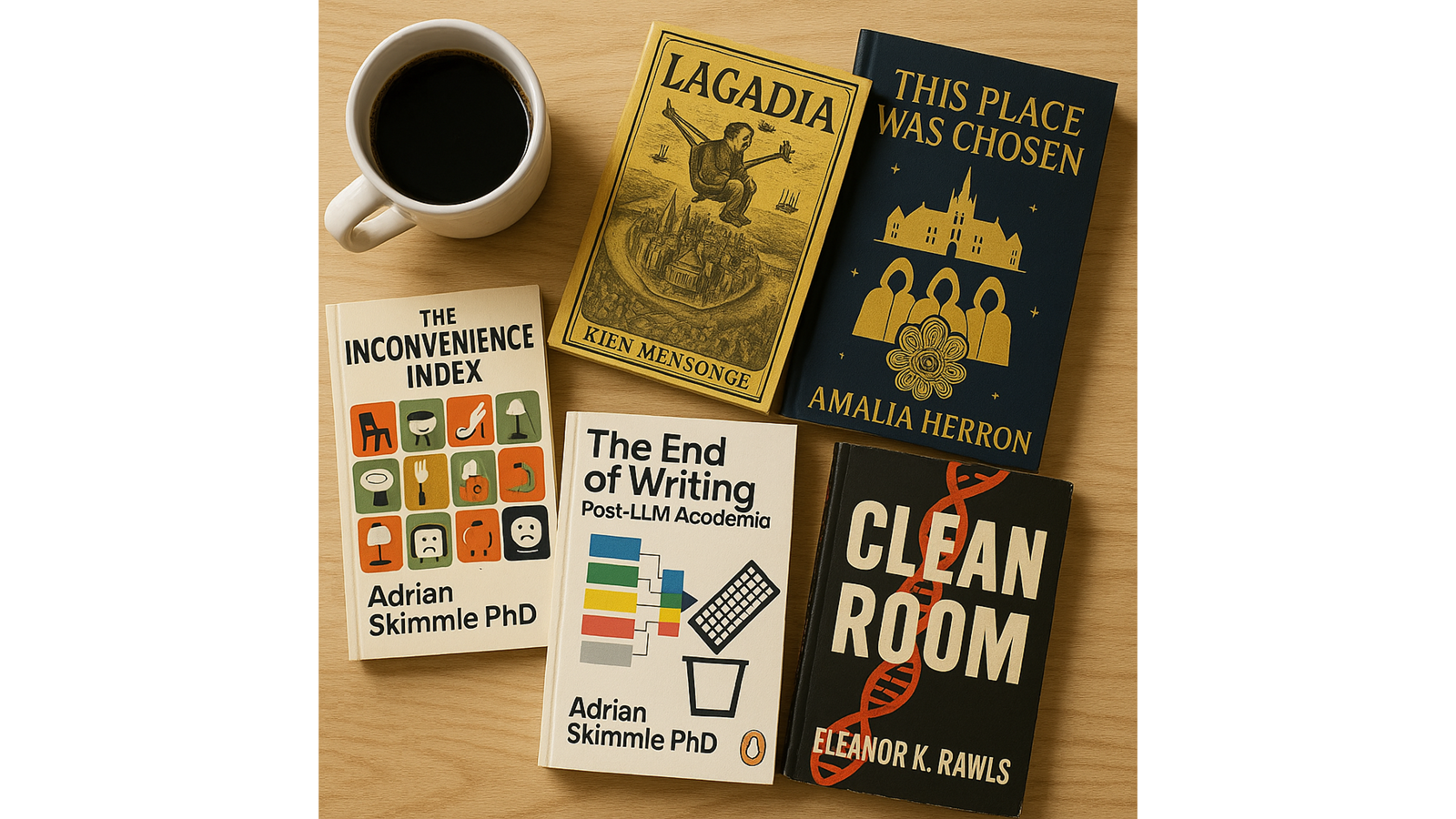
In The Library of Babel, Jorge Luis Borges describes an infinite building made up of hexagonal rooms, each containing thousands of volumes, all 410 pages long. This library contains every possible combination of alphabetical and punctuational mark; although most of the volumes contain nothing but gibberish, it is said that somewhere in this vast archive is every book that could be written. Digital versions of The Library of Babel have already been made to illustrate the concept. In one online version, users can click on walls in hexagonal room plans, zoom in on a volume and read its pages of gibberish. But the storage demands were too great to archive each volume, so the results are created algorithmically (Basille 2023). The Polish science fiction writer Stanisław Lem was also interested in fictional libraries. Imaginary Magnitude (Lem 1973) consists solely of introductions to books that have yet to be written. One of his most prescient imaginary prefaces is, “A History of Bitic Literature,” which introduces five volumes analysing literature written by computers:
By bitic literature we mean any work of non-human origin – one whose real author is not a human being. (He may have been the author indirectly, however, by performing the functions which generated the real author’s acts of creation.) The discipline which studies the entire class of writing is bitistics. (Lem 1973: 41)
The following sections of this chapter are “bitistic” in that they consider AI-generated plots, characters and excerpts from imaginary novels. The media theorist Antonio Somaini makes a crucial observation about latent space and previous archival forms like libraries:
Despite their abstract, mathematical nature, latent spaces have some elements in common with the institutions and the apparatuses that have traditionally played a crucial role in the storing, ordering, processing and accessing of past cultural objects: we can think of libraries, archives and collections, together with their organizing systems, such as catalogues, indexes and card files. Interpreted in this sense, latent spaces are part of the long history of cultural techniques of encoding, organising and mapping, even though in the case of latent spaces that is not entirely perceivable by humans. (Somaini 2025: 48)
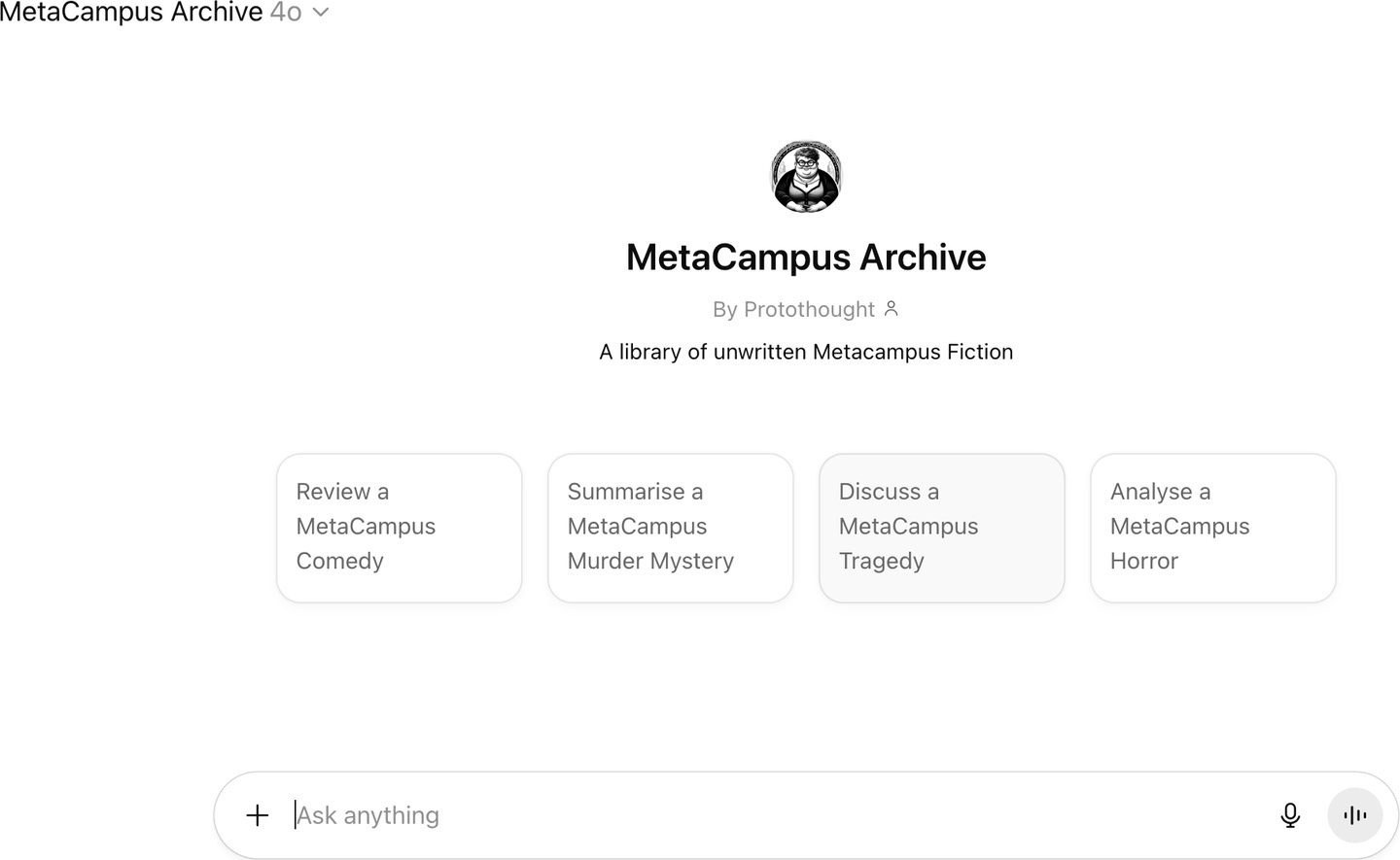
To further explore the latent space of university-based design fictions, I made a custom GPT called “MetaCampus Library” using OpenAI’s GPT builder. The drafts of previous chapters on Campus Fiction and the AI-enabled metaverse literature were used as resources to train this GPT. The initial prompts for a version of the GPT called “metacampus archive” are pictured in Figure 6.1:
The range of material that this GPT produces is far from infinite, but there is enough variation to convey at least the sense of a vast library. Although the GPT was instructed to avoid repeating titles, this was unavoidable because at the time each chat session was independent. This limitation meant that titles reappeared, although plots were different. But human beings also reproduce and reuse titles. When PG Wodehouse discovered how many other novels were already called Summer Lighting, he said hoped that his own might find its way into the list of “the Hundred best books called Summer Lighting” (Wodehouse 1985). In Lem’s introduction to bitistics, there are two main schools of criticism: European and American. The European school interprets computergenerated literature in line with humanities traditions. The American school focuses on the technical production of the texts, and this requires mixed teams of highly specialised computer scientists. But even these specialists cannot know how particular results came about, so this method is considered too time-consuming and unreliable to justify the expense (Lem 1973). As the outputs of GPTs cannot currently be reverse engineered, the “European method” of bitistics will be followed here. The following sections give examples from the library of metacampus fiction from comedies, mysteries, tragedy and horror.
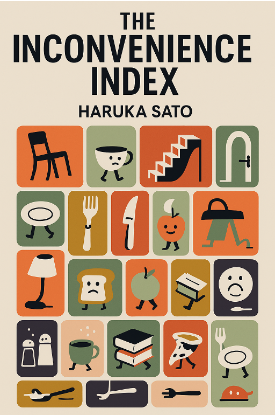
6.1 The Inconvenience Index
As previously discussed, LLMs do not simply return a list of items from a database. Instead, they generate material from a latent space and outputs vary significantly depending on the prompt and even between sessions using the same prompt. For example, text-to-image prompts for “beautiful people” often produce images that reflect culturally constructed and potentially harmful ideals. However, prompts for “beautiful but flawed” or “beautiful and ordinary” can yield more interesting results. The creative use of LLMs depends on critical strategies for navigating the latent space. For this reason, generating a satisfying or interesting result usually involves multiple iterations. The imaginary review below was generated in response to a prompt for a campus comedy that emphasised spatial computing over traditional VR metaverse concepts. The first four or five returns were critiqued and revised to produce the following text:
The Inconvenience Index by Haruka Sato Published October 6, 2035, Pin and Button Press
There is a particular species of institutional absurdity that arises when the language of radical inclusivity collides with the petty ambitions of ordinary people. Haruka Sato’s The Inconvenience Index, her third and most refined campus novel, mines this collision to devastating comic effect.
Set at Graft College, an elite liberal arts institution recently refitted with full-spectrum spatial computing infrastructure – hallways that adjust to your academic focus, seminar rooms that realign based on collective mood data, and a cafeteria that will not feed you unless you can articulate an “eating intention” – Sato builds a world so plausibly absurd that it feels not futuristic but slightly overdue.
The initial outputs were revised by specifying a tone like that of the New York Review of Books. The return here is a good pastiche of the writing found in such publications, although it is rather generous to the imaginary author.
Spatial computing, for the uninitiated, is the practice of embedding digital information into physical space using sensors, AR lenses, and predictive behavioural modelling. In Sato’s hands, this means a campus that watches you more attentively than any professor ever has. And if you appear, even momentarily, to be uncertain, it tries to help.
Zuckerberg’s 2021 keynote on the metaverse pictured virtual realities that would be experienced through headsets. More recently, the focus has shifted towards augmented reality and ideas of “spatial computing.” Initial versions of this review assumed familiarity with such terms, but further prompts suggested parenthetical explanations as above.
Her protagonist, Dorian Plim, is precisely the kind of student spatial computing cannot abide: deferential, indecisive, and gifted in the art of appearing engaged without quite doing anything. After hesitating at a directional kiosk for too long (he was deciding between two equally unappealing lecture options), he is automatically enrolled in a five-week pilot program called Pathways to Activated Belonging. The program’s onboarding document explains:
“We noticed you pausing. In that pause, we heard potential.”
From this point on, the campus begins to respond to Dorian’s body as if it were an interface. Doors open into seminars he did not choose; his dorm room is quietly upgraded to include a “Reflection Basin”; a student wellness representative named Melp appears at his elbow during meals, softly suggesting “possible frameworks of gratitude.”
Initial outputs described the work as “hilarious” despite the examples not being funny. Further prompts specified sources of ironic humour drawing on tropes from sitcoms like Frazier:
Dorian, caught in the feedback loop of institutional care, becomes a figure of tragicomic inertia. He is offered so many opportunities to grow that he begins hiding in low-bandwidth zones just to be left alone. In one scene, he spends three hours inside a defunct climate ethics simulator because it’s the only space on campus where his posture isn’t interpreted as emotional data.
The supporting cast is equally well drawn. There’s his roommate, Todge, who feigns emotional precarity to gain priority access to softseating zones. (“The trick is to cry a little near a plant. They think it’s a yearning for eco-kinship.”) And Grit Vassel, a sardonic student who lives in a sensory dead zone and delivers brutal one-liners like:
“Wellness used to mean you weren’t sick. Now it means you’re profitable to the system of care.”
Although these examples do not match the wit of the suggested sources, they are a good enough pastiche to suggest a book that might be amusing. Beyond the success or failure of the pastiche, there is a suggestive design fiction:
The university itself becomes a kind of offstage character – omnipresent, tonally confused, and increasingly desperate to harvest usable student feelings. In one scene, an overly sincere administrator named Blanda Dree invites students to a “Healing Picnic,” then reports their snack choices to the Emotional Responsiveness Dashboard. Students who choose salty items are flagged for “potentially unprocessed grief.”
“It’s just pretzels,” Dorian protests.
“That’s what the grief tells itself,” Blanda replies, already tapping notes into her lens display.
In addition to the design fiction, the imaginary book satirises the campus culture described in books like The Coddling of the American Mind:
There is no cruelty here – no villains, no sharp ideological satire. What makes The Inconvenience Index so effective is Sato’s choice to resist the easy targets and focus instead on the incremental madness of people trying to function inside a system that endlessly misreads their intentions.
By the final chapters, Dorian has become a kind of unwilling campus legend – a test case in the “Resonant Incompleteness” initiative, which seeks to validate confusion as a mode of learning. He receives a certificate embossed with his own hesitant expression and the words: “Your ambiguity has been heard.”
But the satire is enfolded within a design fiction that develops over time and accounts for resistance:
“Every time I sit down, the chair asks what I’m hoping to understand,” Dorian tells Grit. “I just want to sit. That’s all. I want to sit, and not be interpreted.”
Upon request, many other quotes were generated with varying degrees of success. The one above is not very funny, but it resonates with the HCI research literature which has produced a large number of talking bench projects over the last 20 years. The artificial review ends with the following reflection:
The Inconvenience Index is not a broad satire. It is funnier than that, and sadder. It understands that when institutions adopt the rhetoric of healing, they often lose the capacity to listen. And it leaves us with the uncomfortable possibility that the most human thing left on campus might be a boy hiding behind a vending machine, trying not to learn anything at all.
The tone of this is a close match to that of the New York Review of Books source specified, which is no mean feat as the quality of such writing is
usually high. This output was the result of GPT-4.5; those that were produced by GPT-3.5 were far less successful.
6.1.2 Not Quite Joking
Many of the GPT-3.5 comedy plotlines revolved around older professors struggling to adapt to new technology. Echoes in the Hallowed Halls describes a “befuddled” professor of digital humanities who clings to his paperbacks and chalk dust while struggling to deal with VR. Many plots involved professors or students mistakenly morphing into absurd avatars or finding themselves in surreal virtual landscapes. For example, Hologram Hijinks begins with a freshman experiencing an orientation week involving a zero-gravity mixer where he “hilariously struggles with the physics of floating drinks and conversations and an avatar fashion shoot where someone who is dressed as a Picasso painting humorously disintegrates.” Most of the comic effects in these early outputs were based on surreal or incongruous metaverse landscapes. Avatars Anonymous, for example, tells the story of students fighting a policy requiring them to have avatars that reflect their real-life identities. A prompt for a list of the funniest lines in this book produced the following:
On Avatar Choices: Max chose an avatar resembling a Greek god, but with his tech skills, it turned out more like a Greek salad – a little bit of everything, none of it making sense. Regarding Virtual Protests: We’re staging a virtual sit-in. It’s like a regular sit-in, but with less leg cramps and more bandwidth issues. Leila’s Observation: Feminism in the metaverse is fighting for equal rights while floating as a disembodied head. It’s challenging, but at least I don’t have bad hair days here. Alex’s Comment on Coming Out: Coming out in the metaverse involved less drama but more technical difficulties. My “I’m gay” announcement crashed the server. At the Virtual Sit-In: One student’s protest sign read, “Down with this sort of thing!” Clearly, their commitment to specificity was unwavering. (Avatars Anonymous. )
Although none of these lines are likely to result in anybody laughing, some of them are structured as jokes: the Greek God/Greek salad wordplay, for
example. Some of the lines are somewhat stereotypical and cliched – no bad hair days in the Metaverse. Interestingly, from a copyright point of view, one of the lines is taken directly from uncredited source material. The protest sign saying “down with this sort of thing” was featured in an episode of the Father Ted sitcom, and the slogan subsequently became a meme. It is possible to imagine well-meaning arguments on both sides of a policy around what sort of relationship a student’s avatar ought to have to reality. During the 2010s, many universities adopted a policy of asking staff to state their preferred pronouns at the end of emails. While this was a well-intentioned policy, some people felt “outed” by the process. During the COVID-19 lockdowns, many students preferred to have their Zoom cameras off. This was often because they were in their bedrooms (or even beds), and so a desire for privacy was understandable, but this left teachers trying to communicate with small grey rectangles (Li et al 2022). In Avatars Anonymous, students experiment with different gender or racial identities. It is easy to imagine activists arguing for or against this, and the plot makes interesting use of this provocative design fiction. Simple prompts for artificial comedies (e.g. review a campus comedy) were, on the whole, quite weak but better results could be achieved with more specific prompts. For example, I prompted the GPT for an update of Mary McCarthy’s Groves of Academe plot where a lecturer adopts a radical political position to avoid being sacked for incompetence. An imaginary novel called Avatars of Academia featured a protagonist called Alex Riven, known for their “uninspiring lectures” and “negligible research footprint.” As in McCarthy’s novel, the protagonist is facing looming redundancy until he adopts a new political identity.
Alex chooses to adopt the identity of an avatar belonging to the “Interdimensional Beings” (IDBs), a recently recognized minority group within the metaverse, known for their unique digital characteristics that transcend traditional virtual identity markers. IDBs, often depicted with fluid, shape-shifting forms and a spectrum of luminescent colors that respond to their emotional state, represent users who identify beyond the human-centric avatars, advocating for digital diversity and the acceptance of all forms of virtual existence.
Alex learns the complex digital language of IDB, opting for “nonbinary existence” in both the digital and physical worlds. They become a symbol
of diversity and IDB rights at the university, but face scepticism and backlash from outside and within the movement.
In the end, Alex’s quest for job security evolves into a genuine commitment to the IDB community, leading to a heartfelt confession during a major virtual conference on digital diversity. This act of vulnerability transforms Alex’s relationship with both the IDB community and their colleagues, cementing their role as a genuine ally and advocate.
Mary McCarthy’s book ends with the forced resignation of the administrator who was trying to sack the incompetent lecturer. This version of the story ends in a more benign way, which is perhaps in line with the perfect felicity towards which many classical comedies aim. But GPT-3.5 was likely operating with some form of content moderation filter, or policy alignment “shadow prompt” regarding trans sensitivities. This came across most clearly in GPT-3.5 naming conventions. Despite very specific instructions regarding Dickensian naming procedures, the vast majority of characters in the GPT-3.5 imaginary novels had non-gender-specific names like Alex, Sam or Jordan even when prompts specified that such names should be avoided. GPT-4.5 was far less likely to do this.
6.2 Clean Room

The murder mystery is a highly structured form of fiction, and Showalter speculates that this became a sub-genre of the campus novel because it is a form of intellectual puzzle that appeals to academics. Given the relatively strict structures of detective fiction, it may be expected that large language models would be better at constructing murder plots than making jokes. Even early GPT-3.5 outputs were indeed more satisfying than the comedies, but, again, more interesting outputs resulted from more directed prompts. The prompt for the output below was inspired by a recent conference on the “Future of Human Reproduction” at a UK university. One participant noted that it is now possible to mail order synthetic DNA and suggested this would make a good plot for a murder mystery: someone’s DNA might be copied so they could be framed for murder. The prompt for the following output asked for a review of a campus mystery based on this idea:
Clean Room by Eleanor K. Rawls
Reviewed by M. Thorne Beattie New York Review of Books, May 2031
The notion that someone could be framed using fabricated DNA is no longer speculative. With access to a person’s genetic profile – easily acquired from a discarded coffee cup or a routine institutional screening – it is now technically possible to synthesise matching DNA in a lab and deposit it at a scene. The science is real, the consequences largely unexplored. Eleanor K. Rawls turns this unsettling possibility into the foundation for Clean Room, a taut and tightly structured campus murder mystery set in a near-future college where biological evidence and behavioural data exist side by side, each claiming authority over the truth.
The scientific and fictional premises are neatly established before this plot summary:
Merrow College is the kind of place that prides itself on being ahead of the curve. Its buildings are wired with spatial computing infrastructure – subtle but comprehensive. Movement is recorded by door sensors, air displacement, and voiceprint. Lights brighten when they recognise you; projectors open your files before you sit down. In theory, no one can be anywhere they’re not supposed to be.
So when Dr. Colin Brix, the head of biosafety compliance, is found dead in a Level Three clean room – alone, locked in, and with only one set of DNA evidence present – that evidence is taken seriously. It belongs to Jenn Glass, a second-year postgraduate student in gene ethics. She has no idea how it got there.
Jenn’s presence logs show her in the faculty library at the time. The mesh confirms this: her gait signature, environmental shadow, biometric ID, all aligned. But the crime scene disagrees. Her skin cells are on the gloves, her saliva is on the cup by the sink. Her DNA, it seems, was everywhere.
This is where Rawls excels. The question is not simply whether Jenn is guilty, but how much trust can be placed in systems that are designed to eliminate doubt – and what happens when they contradict one another. The spatial mesh says one thing. The forensic evidence says another. Which counts more?
This plot was the result of several iterations of the idea. The initial outputs were overly dense, laying out interlocking technological and epistemological themes in ways that were overly difficult to follow. Further prompts requested a more straightforward whodunnit, resulting in this:
The novel unfolds with the careful logic of a locked-room mystery, in which the digital security is as impermeable as any physical key. Rawls moves at a measured pace, layering institutional procedures, quiet suspicions, and a slow accretion of pressure on Jenn – who finds herself suspended not by a single accusation, but by the weight of “investigative prudence.” Colleagues stop making eye contact. Her project access is revoked. The building seems to close in around her.
(What follows contains discussion of the ending of the novel.)
–The final reveal is handled with admirable restraint. The killer is not an arch-villain but a disappointed colleague: Nadja Roke, a senior lab manager passed over for promotion twice by Brix. It was Nadja who had access to the college’s secure genome archive – where every student’s DNA profile is stored for lab safety purposes and Nadja who used that access to synthesise trace amounts of Jenn’s DNA. She planted them carefully: a skin flake under a glove cuff, a sealed tube that would be broken during routine postmortem decontamination.
Her motive is not insanity, nor jealousy, but policy. Brix had supported a plan to outsource environmental clearance protocols – threatening to automate Nadja’s role entirely. Her act is premeditated, quiet, and – as Rawls subtly suggests – not designed to destroy Jenn so much as to discredit the college’s trust in its own systems.
What’s striking is how close Nadja comes to succeeding. Jenn is only cleared after a secondary analysis, performed by an outside reviewer, notices a synthetic tag embedded in the DNA fragments – a manufacturing artefact no human sample would include. The college acknowledges the error, but not publicly. Jenn’s record is adjusted; her reinstatement is offered, cautiously, as a matter of “ongoing discussion.” She declines. “I wasn’t cleared,” she says to a friend in the final pages. “I was categorised differently.”
Incorporating institutional politics in a mystery like this is a standard device in campus whodunnits. This strengthens the pastiche but also adds depth to the design fiction, raising troubling real world questions. As we surrender greater authority to AI-enabled surveillance systems, how might they be manipulated – and how might humans appeal?
The great strength of Clean Room lies not in the novelty of its premise, but in the patience of its execution. Rawls does not rely on twists or technology for effect. She is interested in how institutions behave when their procedures produce conflict, and how easily a system designed to be impartial can become a theatre for quiet coercion. The final chapters are devastating precisely because no one is punished – only reshuffled. Nadja is allowed to resign early. The college declines to comment.
This is a mystery novel in form, but an institutional tragedy in spirit. The murder is solved, yes. But justice, in the ordinary sense, remains conspicuously absent.
M. Thorne Beattie is a contributing editor at Data+Fiction and the author of Faculty After Form: Posthuman Campus Cultures in the 21st Century.
A particularly nice touch that adds verisimilitude to this imaginary review is the reference to the reviewer’s own book on a related subject. GPT-3.5 mysteries were not as accomplished, but they are worth considering as historical examples.
6.2.1 Generative Questions
Many GPT-3.5 mysteries involved deep fake technology in the creation of an alibi. Most were set in virtual worlds of one kind or another. Midnight in the Echoing Library, for example, is set in the sprawling virtual campus of Avalonia University, where Professor Elara Mirthfield is found “mysteriously deleted” in a virtual library. A student, Silas Codewell, serves as the detective. Silas examines the digital footprints of those interacting with the professor and notices that log files have been manipulated to support a particular alibi. GPT-3.5 plot summaries were generally very high level, but asking for further details could yield more interesting material. AI characters can be easily developed by asking questions about their backstory, preferences, habits and so on. Plot lines can also be strengthened
through generative questions – What does the protagonist want? What is the antagonist’s motivation? What is the inciting incident? These question-based strategies are often recommended in creative writing guides such as Wonderbook (Vandermeer 2013) and The Artist’s Way (Cameron 1994). Such questions stimulate further development for human writers but also large language models. In response to the outline above, I asked what deletion means in this novel, whether the real-world Professor would be harmed and why they couldn’t simply replace the deleted avatar. The answer to this question was more interesting than the plot that inspired it:
The real-world Professor Elara Mirthfield is not physically harmed by the deletion of her avatar. However, the deletion has significant psychological and professional repercussions. Mirthfield’s avatar is not just a digital representation but a complex integration of her professional work, research, and personal identity within the metaverse. The deletion leads to the loss of years of accumulated knowledge, research data, and personal connections established in the virtual world.
This form of the campus murder mystery then gives an interesting twist to the idea of character assassination. The idea that a user might have a great deal invested in the creation of an avatar is plausible. Today many people devote a great deal of time and effort to building personas for social media (e.g. Hogan 2010). Many influencers are keenly aware that the selves they present on social media are carefully crafted personas which exaggerate certain characteristics and disguise others (Johnson et al 2022). My experience of making the Metaverse Library GPT also supports the idea that substantial work may be embedded in a customised AI. For reasons still unclear to me, an early version of the GPT vanished without trace from my account. I had invested considerable time and effort in finetuning and it was performing well when it abruptly disappeared. This was unsettling, even though the second version I made was an improvement and the first eventually returned, just as mysteriously as it went missing. Whodunnits are a form of comfort literature in that the detective almost always identifies the murderer, ensuring law and order prevail. Tragedies can be more troubling, although they are also a very structured form.
6.3 The End of Writing
The London Review of Books (LRB) is a literary magazine featuring in-depth articles on a wide range of books and ideas. It is known for
left-leaning erudition, and the standard of writing is usually high. To explore this more demanding form through the latent space, I prompted the MetaCampus Library to produce an LRB-style review of tragic campus novels. Such reviews often began with an introduction that situates the work in a historical context. I prompted for a speculative introduction on the impact that initiatives like the Petersen Academy might have on higher education. The Petersen Academy is an online education platform that positions itself as a cheaper and more effective alternative to liberal arts programmes. Its founder, Jordan Petersen, is a deeply controversial figure who sees America’s Ivy League universities as corrupted bastions of “the woke mind virus” (Petersen 2025). Claiming that post-lockdown university programmes are mostly delivered through Zoom sessions with uninspiring PowerPoint slides, Petersen makes a case that his academy can do better with internationally recognised speakers and state-of-theart visuals. The imaginary LRB review of a tragic campus novel begins with an overview of the impact of institutions like this:
The Equity Clause by Maria Kember (Quarterglass Books, 2034)
Reviewed by A.G. Merrow for the London Review of Books, February 2035 issue
At some point in the late 2020s, the university stopped pretending it knew what it was for. The move to immersive and AI-integrated pedagogy – initially described in cautious white papers as “platform-enhanced learning delivery” – was accelerated by a cascade of funding restructures, hybrid credentialing schemes, and one deeply controversial decision: the 2029 Higher Education Recognition Act, which granted degree-awarding powers to new institutions like the Petersen Academy, creating opportunities for many other HE startups offering cheap, quick and entertaining forms of study.
Initially dismissed as an ideologically unhinged Californian bootcamp for “civic cognition” The Joe Rogan Centre for Higher Learning is now the single largest humanities provider in the UK by enrolment. Its simulations are slick, neuroadaptive, and – worryingly – popular.
The so-called “legacy universities” responded in uneven fashion. A few elite institutions rebranded themselves as premium heritage
experiences; others pivoted to consultancy, AI moderation, or digital curation. Some simply disappeared. The language of the university – its rituals, its slow procedures – now circulate as marketing residue.
Again, this output was the result of several rounds of revision prompts. Earlier versions explored in greater detail the political manoeuvring and deal-making that led to accreditation. The fictional politicians typically justified the move as a means of enhancing market competition. The reference to “legacy universities” echoes the rhetoric of social media figures like Petersen referring to “legacy media.” The imaginary review goes on:
This is the setting for Maria Kember’s The Equity Clause, a novel that hovers between satire and tragedy. Its protagonist, Adrian Skimmle, is a plausible enough figure: a former outreach officer who climbed through institutional rubble into a Vice Chancellor’s role at Halewick University. He is sharp, performative, and unencumbered by conviction.
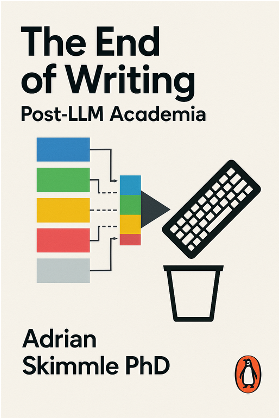
His ascent begins with The End of Writing, a short book he generated entirely through AI. Skimmle claims to have issued countless prompts to shape it, arguing that intellectual labour now lies not in producing text but in staging the conditions under which it emerges. Writing, as traditionally understood, was always about mastering the institutional dialect – what Bourdieu called “the coded speech of social privilege.” In an age of generative systems, that skill is obsolete. Skimmle argues that the business of academics is generating knowledge, not text.
The book is “high impact” cited highly by those who agree and those who are appalled. Overworked academics cite it to justify machinewritten papers; doctoral students use it to defend AI-generated thesis drafts. In internal documents and policy briefings, The End of Writing is described as “clarifying” and “operationally helpful.” Journals begin accepting submissions produced entirely by generative systems, provided the prompting process is “transparently documented.” In a sector under pressure to produce more with less, Skimmle’s’s argument is less debated than adopted. Journals begin accepting machine-generated submissions, provided the prompting logs are included. The book becomes a standard reference for those coming to believe that human authorship is an ethical liability.
The original prompt for the subject of the novel called for a story something like The History Man where personal ambition and careerism are disguised as activism. Early outputs were not very interesting and there were many revision prompts. This back and forth resulted in the suggestion for Skimmle’s book. The subsequent versions of Skimmle’s career resonated with current debates in the academy about acceptable and responsible uses for AI:
Within a year, Skimmle is appointed pro vice-chancellor for Epistemic Inclusion, a newly created role linking digital infrastructure with equity policy. His central claim – that traditional authorship encodes structural bias – is quickly absorbed into institutional discourse. AI, he argues, enables students and researchers to bypass the linguistic gatekeepers of the academy. One pilot scheme replaces essays with prompt logs; another insists on the use of jargon translation tools to “de-centre inherited syntax” in seminars.
His most prominent initiative is Veritas Loop, a validation protocol designed to support machine-generated academic work. It ensures that AI outputs meet citation standards, trace their data origins, and conform to ethical prompting frameworks. Skimmle presents it as a safeguard for contributors whose intellectual labour might otherwise be dismissed as derivative or unverifiable. Skimmle is invited to keynote a digital governance summit in Seoul, appears on expert panels and receives several invitations to government policy think tanks.
Because this imaginary novel follows Booker’s tragedy structure, the brief period of success must be followed by catastrophe:
The unravelling begins quietly. An internal quality assurance review – routine, almost perfunctory – includes a retrospective sample audit using the latest build of Veritas Loop, now upgraded to meet new sector-wide compliance standards. Among the sample texts is The End of Writing. The system flags anomalies. What was assumed to be an AI-generated document – praised precisely for its neutrality and authorless clarity – shows a single, continuous human signature throughout. Layered revision histories, long-form structuring patterns, and recycled phrasing drawn from an earlier, unpublished manuscript are all identified and reconstructed. The
results are unambiguous: the book Skimmle claimed not to have written was, in every substantive sense, written by him.
At first, the implications are unclear. Veritas Loop had not been built to detect fraud – only to validate machine use. But the story spreads quickly. Within days, briefing papers are quietly revised. Citations to The End of Writing begin to disappear from institutional frameworks. A scheduled keynote at the Open Knowledge Federation is cancelled “due to scheduling adjustments.” Skimmle does not comment. For several weeks, the silence holds.
Previous versions of Skimmle’s downfall concerned a different and unrelated design concept. This was a VR experience where local people could access university data and oral histories about their area through AR wearables. The scandal resulted from revelations about material for this being fraudulently appropriated from unauthorised sources, including a pornographic VR game. The version below resulted from prompts directing for a more thematically relevant downfall which developed as follows:
The tribunal is brief. By the time it convenes, most procedural outcomes have already been negotiated. Skimmle appears drawn but composed. He does not dispute the findings. His defence, delivered in a tone bordering on fatigue, rests on intention. “People trusted it,” he says of the book. “They wouldn’t have if they’d known it came from me.” He speaks of epistemic climate, emergent form, machine legibility. It fails to convince.
The only moment that breaks the room’s professional stillness comes during the testimony of his former wife, a librarian who had once worked on Halewick’s citation ethics project. Her statement is brief. She confirms that passages from The End of Writing resemble material from earlier drafts she had read during their marriage. She characterises Skimmle as a pathological liar as evidenced by his numerous affairs. “He told the university he had no voice. But he had one. He just didn’t want anyone to recognise it.”
He is dismissed within the week. Citations are withdrawn, profiles taken down, conference rosters quietly restructured. For a time, there is no public trace. Then, several months later, his
name appears – unremarked – on the staff listing at Rothley Hall, a former collegiate university now operating as a heritage venue and executive retreat. Visitors are offered cream tea in the Senior Parlour, where archival portraits shimmer faintly with augmented gloss and recorded voices trail through the rafters. Skimmle works as part of the hosting team. He pours tea, makes conversation, and gestures politely toward the library when asked about the history of the college. His name tag reads simply “Academic Fellow.” On quieter days, he is sometimes mistaken for an animatronic.
The tone of the review also went through several drafts. Early iterations were very hostile to the book as the initial prompt asked for a highly critical review. But as the story developed, this tone felt increasingly jarring. The version here remains critical but more nuanced.
Kember’s novel is not subtle, but it is carefully shaped. It understands that institutional life is now built on simulation and substitution: writing without thought, education without teaching, impact without presence. Skimmle isn’t a villain – just the kind of person these systems select for. The tragedy is not that he is exposed, but that, for a moment, he almost got away with building something that felt like it mattered.
A.G. Merrow is a contributing editor at Parallax Quarterly. Their most recent book is Grievable Knowledge: On the End of the University.
As a long-time reader of the LRB, I consider this a successful pastiche of its style. The language is poetic without being ovelry pretentious, and several phrases resonate in the context – particularly “writing without thought” and “education without teaching.” Other versions of this article ended with elegies for “the old idea of scholarship as attention.” Another rejected ending described the prompt “as the new medium of academic life,” which felt a bit too close for comfort.
6.3.1 Artificial Critical Theory
Again GPT-3.5 reviews were far less accomplished but perhaps of historical interest. The impact of new technology on student mental health was a persistent theme in GPT-3.5 campus tragedies. For example, in Shadows of the Veritas Virtualis by Magnus Eldridge, students take part in virtual anthropological studies of a fictional island called Aeloria, based on a mix
of Polynesian and Melanesian cultures. An AI creates a complex social hierarchy, drawing on historical data to recreate tribal conflicts over resources. The AI not only misrepresents the source material but subjects the students to traumatic experiences of battle which provoke panic attacks and selfharm. This story echoes the famous Ray Bradbury story “The Veldt” which is an early depiction of VR albeit in the context of a childminding facility. I used GPT-4.5 to critique Shadows of the Veritas Virtualis specifying the notoriously difficult prose style of the cultural critic and theorist Judith Butler. It produced the following response:
If, as has been argued, the pedagogic interface is always already complicit in the performative constitution of its own epistemic ruptures, then the machinic didacticism at stake in Eldridge’s mediatized fable must be read not as an isolated narrative gesture but as a symptomatic iteration of the broader techno-discursive dispositif through which affect, alterity, and algorithm become co-constitutive. What emerges is not a subject interpolated into knowledge, but a subject dissolved in the recursive auto-affection of the virtual ethnoscene. To the extent that Eldridge’s text gestures toward an ethics of mediated encounter, it does so only through a parodic intensification of the pedagogical form – a hyperstitional enactment of epistemic vertigo wherein the student-as-subject becomes legible solely in terms of their disintegration within a regime of simulated authenticity that cannot not fail to reproduce the very violences it ostensibly seeks to redress.
Again, this strikes me as a convincing pastiche which stays on the right side of parody. A passage written by the real Judith Butler won a bad writing contest run by the journal Philosophy and Literature in the late 1998. I quote the passage in full for comparison with the AI imitation:
The move from a structuralist account in which capital is understood to structure social relations in relatively homologous ways to a view of hegemony in which power relations are subject to repetition, convergence, and rearticulation brought the question of temporality into the thinking of structure, and marked a shift from a form of Althusserian theory that takes structural totalities as theoretical objects to one in which the insights into the contingent possibility of structure inaugurate a renewed conception of hegemony as bound up with the contingent sites and strategies of the rearticulation of power. (Butler cited in Pinker 2014: 36)
In his book A Sense of Style, Stephen Pinker observes that here, Butler layers abstract propositions and qualifies them with further abstractions (Pinker 2014). Neither the real passage from Butler, nor the AI pastiche are nonsense. In plain English, Butler argues that ideas about power takes different forms over time. The pastiche can be similarly paraphrased– using VR to teach students about other cultures may confuse, overwhelm or harm them. But these meanings are buried deep in specialised references and what Strunk and White call “ten-dollar words to make you look smarter” (Strunk and White 1959). It may be that AI can already write more clearly than many academics. If nothing else, it may be a useful translation tool for this kind of bad writing. But what happens to universities more broadly when AI outperforms humans not only in writing but most other tasks?
6.4 Vallance’s Travels
The design fiction in this section takes the form of a tour around several universities. It began with a prompt for an article in the style of The Higher Education Supplement (THES) reviewing a book on changes in design education around the world. This went through more iterations than any of the previous examples, partly because the brief was complex. There were over three hundred revision prompts, with multiple refinements for structure, tone, content and concept design. The total number of words generated across drafts was between 90,000–100,000 words with just under 3500 in the final draft. Terms like “vibe coding” are already emerging for programmers who describe what they want using natural language and keep revising prompts until the generated code functions in the ways they intend. I am not sure what to call the process that resulted in the fiction below. It is not quite writing but neither is it “prompt engineering.” Perhaps it is something like “text design” or “text direction” if that’s less ghastly. As this form of generative text design becomes more common, it is important to consider how we evaluate such outputs. As Jack Carroll notes:
Solutions without stories (and stories without critical analysis for that matter) are interdisciplinary errors. (Carroll 2025 pers comm)
The following section considers each section of the very long and detailed fictional THES article in terms of the criteria used to produce each section.
Vallancé’s Travels: A Tour of Post AI Design
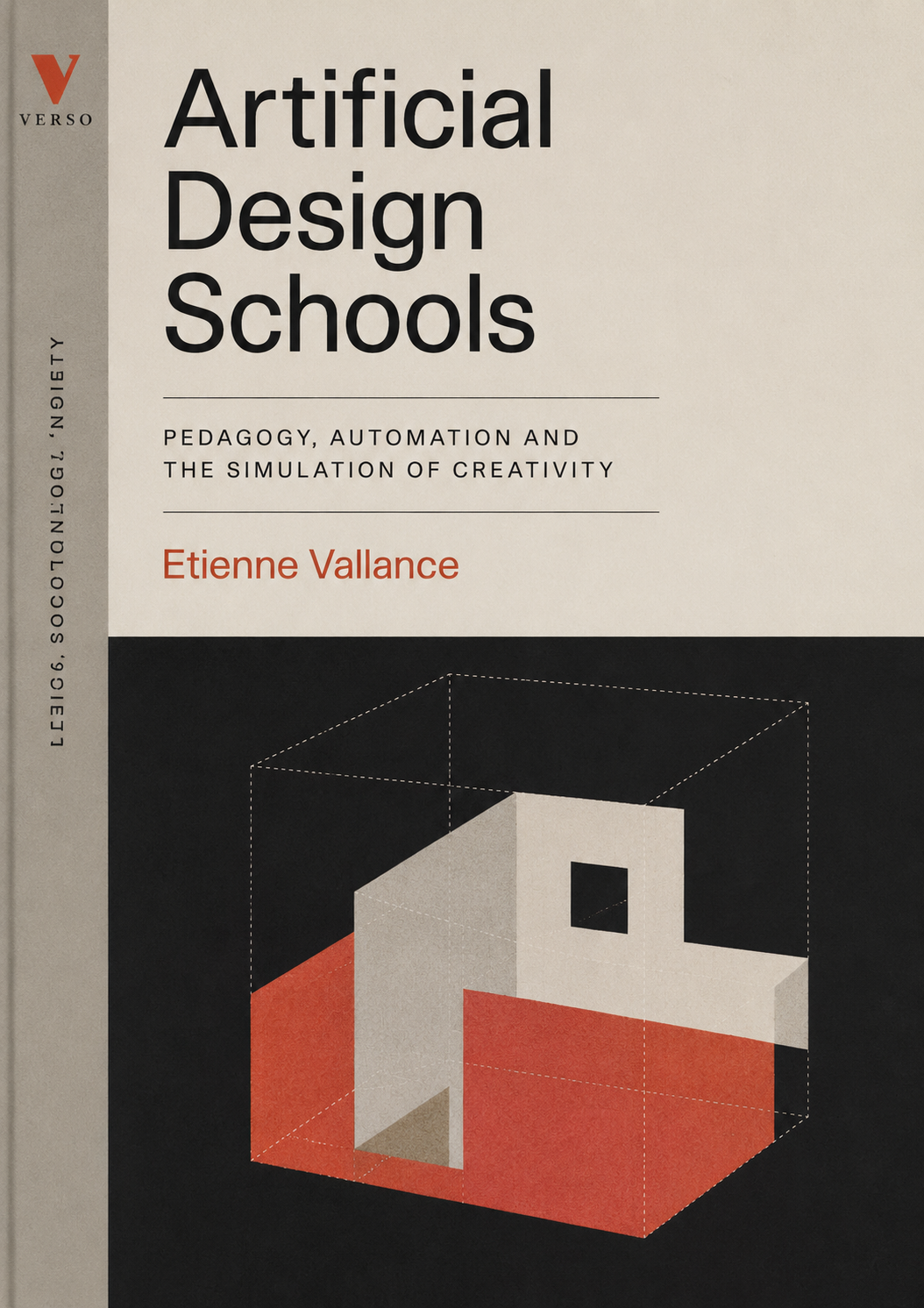
Artificial Design Schools by Étienne Vallancé (Verso Futures, £28) July 22. 2036 Amalia Herron
Times Higher Education Supplement
What happens to design education when the tools students once trained to master can now outperform them? Artificial Design, Étienne Vallancé’s account of post-AI design teaching, follows that question across seven institutions on five continents. The result is a book that neither forecasts nor warns but watches nervously.
By the early 2030s, a crisis had taken hold across higher education. Enrolments collapsed. Departments merged or disappeared. Entire universities rebranded, dissolved, or reconstituted themselves as cultural platforms, accelerators, or experience labs. New institutional forms emerged almost as quickly as old ones closed. The word “design” persisted – perhaps because it had always been vague. Once commonly qualified by discipline – graphic, product, or fashion – it was now more likely to appear with modifiers like: generative, adaptive, bio-responsive.
Between 2032 and 2035, Vallance – a former sub deputy vicechancellor of Lyone’s École des Systèmes Visuels, now working in senior strategy for a European innovation council – visited design schools across the UK, the US, continental Europe, Asia, and the Middle East, observing how design studios had adapted – or capitulated – to the growing dominance of generative AI. In all cases, the meaning of “design” has evolved: no longer mastery of form or craft, but negotiation with systems that exceed the designer’s talent or intent.
The speculative frame of this tour of institutions was inspired by a realworld project where a Technical Director at a UK university interviewed staff at several world-leading design institutions (Savage 2025). The first revisions focussed on adopting a style in line with THES journalism. Early iterations featured five global locations which expanded to nine, but early outputs felt too much like ploughing through a list. I experimented with organising the material by theme, but it was still difficult to keep track of so many locations. The final versions followed five institutions
with various kinds of partnership projects to include more locations and different styles of work.
A little revolution, tastefully lit, RCA, London
At the Royal College of Art in London, Vallancé finds a studio culture still fluent in irony, but increasingly unsure what to do with it. One wall-sized projection fades between AI-generated simulations of alternate alumni futures with graduates like Tracey Emin as Minister for Information. The work is often conceptual, sometimes baffling but always beautifully executed. One RCA student presents a wearable, designed to reduce stress in urban hedgehogs affected by construction noise. The soft harness uses acoustic baffles and a biometric patch to monitor stress signals.
Elsewhere, three ceramic bowls, each grown from a different fungal matrix, sit on plinths in a pool of changing light. Nobody explains what they’re for. Vallancé notes that passersby seem moved to speak quietly in their presence, “as if unsure whether they’re tools, offerings, or a test.”
Garments hang from translucent rigs, slowly reshaping themselves in response to shifts in facial expression. Tutors describe the process not in terms of cut or technique but as “choreographing atmospheres.” Vallancé notes that few of the works appear complete, and fewer still appear to be marked.
The RCA is one of the most famous UK schools of Art and Design. It is the institution where speculative design originated and the first line of the review neatly expresses the problem of what happens when irony becomes institutionalised. The novelist David Foster Wallace was troubled by irony. He pointed out that in the 1960s, irony could be read as subversive. But in the 1990s, after three decades of this mode dominating popular culture, it became something else. It was no longer subversive but rather numbing. Wallace would counteract the effect of watching too many episodes of The Simpsons with a walk in nature. Initial iterations of the RCA section were overly parodic. The hood for hedgehogs, for example, had a QR code which linked to an audio poem. This tipped from pastiche into parody, so it was revised as above.
In a side gallery at the RCA, Vallancé visits a group of community makers – non-academic technologists hosted through a civic outreach scheme. Older and mostly self-taught, they work with salvaged parts. A nostalgia bench, once programmed to play local oral histories, now repels users with parking infractions. A smart kettle, repurposed from a posture-correcting yoga device, won’t boil until the user sends an overdue email reply. In a nearby gallery, a servoupgraded Boba Fett action figure sweeps the floor while chanting slogans like “Exist. Resist. Persist.” The work is eccentric, glitchy, but sometimes unexpectedly tender.
The RCA, he concludes, seems largely insulated from the vocational pressure reshaping most UK institutions. A growing number of students now fund their studies through long-term, income-linked loans modelled on the American system – a shift that, in effect, returns postgraduate education to an older pattern: creative freedom for the indebted, and soft patronage for the rich.
In Cory Doctorow’s novel Makers (2009), a pair of eccentric inventors live in a scrapyard where they scavenge parts from discarded technologies and junk to make collectable art projects – like a cluster of “Boogie Woogie Elmo” robots which co-ordinate themselves to drive a car. These makers are lovable nerds who espouse a DIY philosophy, using discarded tech and 3D printers. This book was referenced in prompts for the community of makers hosted at the RCA under some sort of outreach arrangement. Although the work at the RCA is politically egalitarian, it has been criticised for being an elitist institution addressing “first world” problems. For most of the 20th century, UK higher education was funded by the state, but the Labour Government under Tony Blair introduced individual student fees of up to £1000 in 1998, and a Tory coalition led by David Cameron increased the figure to £9000 in 2010, making higher education inaccessible for many people. The final section of the imaginary THES review reflects ongoing funding concerns and the risk of a return to previous patterns of patronage and exclusion. Politics has a much more direct impact in the MIT section of this review:
Contingent Design in an age of collapse, MIT Cambridge (MA)
At MIT, Vallancé finds none of the lingering ambiguity he encountered in London. The tone in Cambridge is brisk, procedural, and
lightly paranoid. Design is contingency planning – an anticipatory practice concerned with crowd dynamics, infrastructure stress, and civil obedience. Nobody refers to the national context directly, but several interviewees mention “precarious stability” and “distributed resilience architectures” in a way that leaves little doubt.
In one lab, students are testing prototypes for non-lethal dispersal systems: acoustic veils, adhesive fogs, drones that emit optical confusion fields. Another group is developing predictive riot maps based on consumer returns, school closures, and church attendance. One student presents a self-calming vest for field medics that tightens gently at the shoulders during moments of threat.
The civil disturbances are deliberately ambiguous. The increasing polarisation of recent American history makes the scenario plausible, whichever party is in power:
Assessment at MIT is automated but unrelenting. Students rarely dispute feedback. Reflection is expected. One module, listed as Design Ethics and Iterative Self-Alignment, includes weekly “constructive humility” cycles in which Artificial Directors prompt students to re-evaluate their decisions in light of contradictory narratives. Vallancé notes that several students appear to rehearse these sessions in advance – with a degree of nervous precision that suggests not performance, but terror.
Funding is explicitly tied to the agenda of the government of the day – a policy framework that reverses direction frequently as coalitions shift. The result, Vallancé observes, is a studio atmosphere that feels flustered, nervous, and permanently on edge. At an award ceremony the Head of Architectural Defence takes to the stage and describes the accepted and established organisational hierarchy as (1) ADs (artificial directors), (2) administrators, (3) furniture, (4) students, and (5) faculty. He was joking but the laugher was somewhat nervous.
The award ceremony is a modified version of a real event recorded in the inspirational source material (Savage 2025). Universities have been a prime focus of the recent “culture wars” and the Trump administration cancelled a wide range of research programmes when it came to power in 2025. Revision prompts suggested that evaluation might look something
like a “struggle session” as research is increasingly politicised. The following section is a somewhat utopian relief from this dark material.
Education as leisure, research as play Tu Delft, The Netherlands
At Delft, Vallancé finds no such pressure. The mood is loose, slowmoving, faintly botanical. Students work in groups or alone, often outdoors under trees. There are few presentations, fewer critiques. Most projects seem to evolve horizontally, nudged along by faculty figures known as co-formers – occasional presences who drift in and out of studio life like amateur botanists. The university is collaborating with a network of Scandinavian schools – mostly in Sweden and Finland – on “anticipatory ecologies,” though nobody defines the term in quite the same way.
Some students are developing post-human infrastructures for urban wildlife: pigeon-scale scaffolding, moss-fed lighting systems, wasp-compatible ventilation. Others are working on printable concrete shelters for post-blast zones – a reconstruction protocol already deployed in limited areas of the Baltic region. The shelters are modular and ugly but quick to print.
A team working on climate-responsive furniture has built a table that tilts as the room warms. Nobody seems sure what it’s for, but everyone agrees it’s “useful to think with.”
“More than Human” design advocates for a relational design practice including animals, ecosystems, and materials. The reference to the table suggests real-world research artefacts like “table non-table” which is made of 1000 sheets of paper and moves very slowly (Wakkary 2021). Ron Wakkary describes such designs as “counterfactual artefacts” which invite reflection. There is perhaps a trace of parody in “nobody is sure what it’s for,” but this is balanced by the notion that it is useful to think with, which seems faithful to the philosophy.
Near the edge of the Delft campus, Vallancé finds Rafael, a student in Material Semiotics, seated in a vaulted alcove that once housed water pumps, now overgrown with wisteria. On his desk sits a single object: a digital missal – a curved folio overlaid with shifting text rendered in golden calligraphic filaments. The pages adjust to the reader’s breath,
but offer no interaction, only presence. Vallancé doesn’t understand the functionality but describes it as the most beautiful object he saw on the tour “like belief, without claim or explanation.”
There are no timetabled crits. Tutors appear to visit by invitation. One professor asks Vallancé if he’d like a coffee, then gives him a small chair and suggests he “stay for the afternoon and see what emerges.” He does. Everyone is there entirely by choice, supported by the Vrijvond Act which guarantees a civic stipend in exchange for access to personal data. Most staff come for access: to advanced fabrication tools, to the design intelligences known locally as ontoware, and because – as one of the co-formers observed – work is more fun than fun. Still, Vallancé leaves with the quiet sense that all this serenity might be the surface tension of a deeper uncertainty – not absence of need, but a subtler form of pressure. After all, when everyone is paid to be here, who’s really free to leave?
Rafael was a late addition following a revision prompt asking for a Catholic student working on something intended to embody the beauty of medieval illuminated manuscripts or great religious art. Although there is very little HCI research on spirituality, there have been several calls for work of this kind which point out that religion is still important to the global population even if it is no longer important within the academy. The Vrijvond Act is again deliberately ambiguous, suggesting a social backdrop where something like universal basic income has been implemented with some sort of data/surveillance exchange. The final line was a revision prompt added to undercut the techno-utopian tone, which is further undermined in the next and most bleak section.
Luxury Futures, Curated anxieties, Pavilion of the Possible, Dubai
In Dubai, Vallancé is met at the transit threshold by two student aides in gait-correcting Jimmy Choo sandals which, they point out, help regulate posture and mood. The design school, known as The Pavilion of the Possible, occupies a private zone within a kilometrewide mirrored dome built in engineered desert. Officially it is part of a regional university alliance, but in practice it functions as a climate-controlled invention palace for the heirs of sovereign wealth. Its primary donors include royal family offices, private equity collectives, and logistics conglomerates with mineral contracts in the Congo and
Mauritania. Students from those states are admitted on fully funded placements, but almost exclusively drawn from governing families. One hallway is known, unofficially, as The Sons’ Wing.
Inside, the temperature never changes. In place of studios there are environment suites: domed interiors with climate-responsive floors, ambient fragrance control, and panoramic projection walls. In one room, a group is prototyping a line of garments that fluctuate in opacity according to the wearer’s influencer score. The effect is immediate and unmissable – bodies rendered selectively visible in proportion to social visibility. Staff offer hushed praise.
Elsewhere, a banished princeling demonstrates a personalised worldstream in which he is simultaneously a Formula One driver, a porn star, and a misunderstood conceptual artist; an AI named “slave” offers gentle ethical critique and is smashed to pieces with a Womb Chair.
The architectural reference for this school is the planned mirrored linear city known as “The Line” envisioned as a car-free, zero-carbon settlement. Dubai is associated in the cultural imaginary with astonishing wealth and concentrated luxury. The links with the Congo and Libya were based on speculations about regional tactical alliances that might provide access to elements critical to high-tech consumer electronics.
Vallancé is not granted access to the Measureless Caverns, a heavily restricted annex beneath the pool gardens. But he hears rumours: partially biological sex robots capable of hosting ferocious sadomasochistic fantasies without risking accidental death; synthetic species engineered for symbolic hunts; bio-tech supported VR modules for the performance of monstrous desires. The facility is marketed to anxious parents as a therapeutic containment zone, a way to “safely exhaust” the energies of difficult and troubled heirs. There is a research literature supporting this approach, but Vallancé notes that the supporting evidence is limited and its interpretations highly contested.
The contrast with the Pavilion’s Islamic design annex – co-managed by an institute in Cyberjaya, Malaysia – is stark. Here, students work on devotional technologies and spiritual UX systems. One group is developing symbolic burden devices – wearables that
grow incrementally heavier when the user acts in conflict with their declared ethical framework. A third project involves an AI trained on centuries of Islamic jurisprudence and spiritual writing, which occasionally interrupts students mid-design to ask, “Would this honour the body?” or “Whose fear does this serve?”
The first paragraph is based on the well-documented excesses of the adult children of dictators like Al-Saadi Gaddafi. The pleasure dome was revised with reference to Coleridge’s Kubla Khan and most specifically the “caverns measureless to man.” The concentration of wealth in Dubai is not contestable, and the sometimes-sadistic excesses of the super-rich are also a matter of public record. But the representation of the Dubai Pavilion felt unbalanced and stereotypical in its early iterations. The Islamic design annex was prompted as a balance to these negative representations to emphasise opposing spiritual and intellectual traditions. The final section addresses a very different context in China.
Nothing Left Unmeasured, Central Academy of Technocivil Design, Beijing
At the gates of the Central Academy of Technocivil Design – a merger of several elite Beijing institutions – Vallancé surrenders his phone, passes a voice-pattern check, and is assigned a liaison with diplomatic clearance. He is not permitted to wander. The visit proceeds via designated viewlines, each carefully aligned with national development goals. Official signage describes the school’s mission as “ensuring harmonious futures through affective infrastructure.”
In the first room, a group of students present an emotion-responsive commuting pod designed to reroute itself when passengers exhibit signs of interpersonal friction or ideological stress. It uses facial heat-mapping, olfactory inputs, and dialogue tracking to select quieter routes and subtly adjust atmospheric scent. “The pod,” a student explains, “learns what kinds of conversations produce dissonance and seeks to pre-empt conflict.”
In a neighbouring studio, Vallancé is shown a dormitory wallpaper that detects tonal markers of sarcasm. When triggered, it emits a faint electric rustle and develops a shallow blister across the surface. The aim, he is told, is “early ethical redirection.”
The Chinese “social credit system” rates individuals, businesses and institutions for trustworthiness based on legal records, online conduct, public service use as well as data from public surveillance systems tracking activities like jaywalking or fare dodging. It is a complex and evolving system that draws various data sources together. But it does not provide individual scores, as in some Black Mirror episodes; the social credit system is a complex and evolving set of policies. The tone here is verging on parody. But open sarcasm is less common in China than in the West and can be considered rude or shaming. So, it is not unthinkable that designers might explore ideas for monitoring it.
Vallance asks whether there is anything the state imagines is none of its business. His liaison smiles, nods once, and ends the visit fifteen minutes early. No further rooms are shown. Vallancé is returned to his hotel by private shuttle, where a receptionist hands him a white envelope containing a thank-you note, a brochure, and a QR code linking to his own social credit index based on scores extrapolated from commercially available European banking data.
Although Westerners may consider the social credit system totalitarian, it is worth remembering that institutions like banks and Amazon hold at least as much information about us. The original QR code in an early version of this section linked to an internal Chinese index, but I thought it more interesting to link to something purchased from European data brokers. The imaginary review concludes as follows:
Overall, Vallancé ‘s quietly gripping book does not suggest a coherent future for design so much as a fragmented and unstable one. What emerges instead is a set of competing instincts: towards control, toward play, toward healing, spectacle, sanctity, survival. There are places where design education looks like weapons testing, others where it resembles soft diplomacy or therapeutic theatre. At times the reader wonders whether these are still universities at all, or something closer to subsidised dream-tanks for divergent national desires. Vallancé rarely editorialises, but his route and tone betray a quiet unease: the word “design” has survived – but its meanings have multiplied beyond consensus, and its teaching has become inseparable from power.
The format of the “voyage” through various design fictions is discussed in Chapter 2 with examples like Bruce Sterling’s Distraction, Mobile Life’s IKEA brochure and the TBD catalogue. The advantage of speculative
frames like these is that they allow for the exploration of multiple futures rather than singular dystopian or utopian visions. As noted, this underwent multiple iterations and hundreds of revision prompts before I edited it myself. As subsequent models improve, less editing will be necessary and their use will become more common. How then are we to evaluate this kind of artificial design fiction?
6.4.1 Cliché and Formulae
The MetaCampus Library ran on GPT-3.5, GPT-4.0 or GPT-4.5 depending on daily allowances. The GPT-3.5 version was so fond of the phrase “rich tapestry” that I wrote specific instructions prohibiting its use. Even so, the rich tapestries continued to come through. Much of the material GPT-3.5 generated would have excited the ire of literary critics like Martin Amis, who considered good writing to be a “war against cliché” (Amis 2001). For example, I asked the MetaCampus Library to discuss a literary novel about a team of researchers developing treatments for anxiety disorders. It returned the decidedly non-literary title: Circuits of Solitude with a plot about a professor who develops “Neurosynth Therapy.” The plot was somewhat engaging, and the design fictions reasonably plausible. However, it was much less successful in creating the style of a literary novel. I asked it to quote an example of beautiful writing from the novel and it supplied the following:
As the sun dipped below the horizon, casting a soft, amber glow over the Metacampus, Dr. Collidge stood alone, her gaze lost in the distance. The sky transformed into a canvas of purples and oranges, mirroring the tumultuous sea of her thoughts. ‘“In this twilight of technology and humanity,” she whispered, “where does one end and the other begin?” The breeze carried her words away, mingling them with the whispers of leaves and the distant hum of the city, as if nature itself pondered her query. (MetaCampus Library GPT-3.5)
This example is heavy with cringeworthy cliché – her gaze is “lost in the distance,” her thoughts are a “tumultuous sea.” Not only does the wind carry her words away, they mingle with the “whispers of leaves.” But this is unedited GPT-3.5 text. The following is a rewrite from GPT-4.0:
She had passed the last of the windows, where the electric light shone cold and steady in the glass, and beyond it the dusk thickened, folding into the edges of things, softening outlines without obscuring them;
and underfoot, the firmness of the path gave way to something looser, the dry give of leaves and earth long untended. The old distinction – between what lived and what calculated – had thinned, as old cloth frays with handling, the weave loosening slowly, imperceptibly. Behind her, the low rhythm continued – even, unerring, indifferent.
This more literary rendering was not simply the result of the new model. It was prompted with specific references to Virginia Woolf, in particular a passage from The Waves –
Gradually as the sky whitened a dark line lay on the horizon dividing the sea from the sky and the grey cloth became barred with thick strokes moving, one after another, beneath the surface, following each other, pursuing each other, perpetually. (Woolf 1931)
The revised version went through 23 detailed revision prompts: eliminating persistent clichés, modifying anthropomorphic metaphors, developing similes, suggesting word substitutions and reshaping syntax. Of course, the resulting text still does not match the beauty of Woolf’s prose-poetry. And it may be argued that whether it is an improvement or not is merely a matter of taste. As in Educating Rita, this is a different song, not necessarily a better one. CS Lewis once pointed out that it is almost as difficult to say why something is bad as it is to say why anything is good. As previously noted, one of the standard measures of good or bad writing is the presence or absence of cliché. “The War Against Cliché” becomes more ironic with the passage of time and the multiplication of wars against abstracts like drugs, terror and poverty. But Amis makes this argument:
To idealize: all writing is a campaign against cliche. Not just clichés of the pen but clichés of the mind and clichés of the heart. When I dispraise, I am usually quoting clichés. When I praise, I am usually quoting the opposed qualities of freshness, energy and reverberation of voice. (Amis 2001)
Writers like Dan Brown, JK Rowling and Stephen King, though phenomenally popular, are routinely castigated as bad writers because critics have detected clichés in their work. When Stephen King was given a national book award, Yale literary scholar Harold Bloom argued that this was a
symptom of a national “dumbing down” (Bloom 2000). He also declared that 35 million book buyers were wrong about Harry Potter. His main reproach was Rowling’s clichéd writing, claiming the phrase “stretched his legs” is used in Harry Potter and the Philosopher’s Stone “several dozen times” (Bloom 2003). This claim is now easily checked and a search of the e-text shows that the phrase “stretched his legs” does not appear at all and the phrase “stretch his legs” only once. Stephen Fry has argued that an ability to create compelling plots is a far rarer gift than the ability to produce poetic phrasing. Whatever the failings of GPT-3.5’s prose, many of the artificial plots were better than any that I could come up with myself, as evidenced in the Lagadia section of this book.
6.4.2 Towards Evaluative Heuristics
There have been at least five phases of evaluation in studies of Human– Computer Interaction: (1) engineering, (2) computer science, (3) cognitive psychology, (4) HCI professionals and (5) experience (Kaye and Sengers 2007). Following the turn to experience, there was a greater engagement in methods from the humanities and critical theory. Despite a plethora of method papers, evaluation remains problematic. However, there has been a shift of emphasis from binary judgements to more nuanced discussion. Baumer et al (2020) argue that evaluation criteria for design fiction must vary depending on the reasons for making it e.g. exploring a new space or refining an existing idea. In heuristic evaluation, users with a degree of expertise reflect on a system’s performance against a set of heuristics, for example usability criteria like time on task, accuracy and ease of use. What might a speculative AI heuristic look like? The log of the dialogue that produced the imaginary THES review was approximately 80,000 words long (about the length of this entire book) although there were many repetitions between iterations. I gave GPT-4.0 the record of this log and asked it to identify prompting patterns. It listed:
plausibility within a specific institutional or cultural context, worldbuilding through detail rather than explanation, conceptual diversity, avoiding solutionism, stylistic constraint and tonal coherence, emotional range and thematic depth.
It also suggested the following heuristic:
Function Follows Weirdness
Ask: Is this strange idea doing something – however minor, absurd, or poetic?
You supported absurd designs (e.g., repurposed smart kettles, hedgehog hoods) only when they had a logic or function, even if tenuous.
Unanchored surrealism was rejected unless it had behavioral, emotional, or systemic consequences.
“Useless” designs were allowed – but they had to be useless in a specific way (e.g. spiritual, ritual, humorous).
Of course the LLM is listing likely critieria rather than execuitng a reliable analysis but it seems plausible to me althought I would also stress critical provocation. The following design fiction is more fantastical than the previous, but more provocative despite (or perhaps because) it takes a gothic form.
6.5 This Place Was Chosen
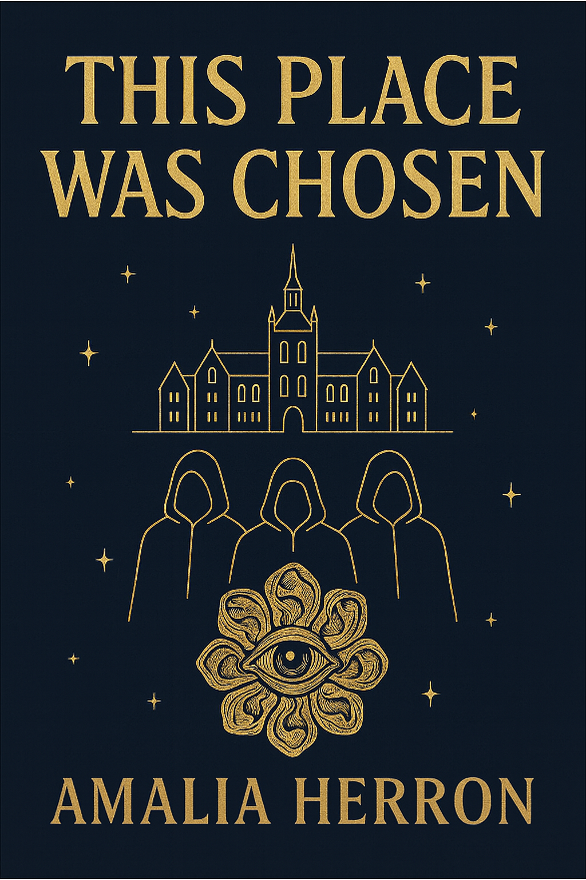
The following artificial LRB review was the result of an initial prompt asking for a review of gothic-horror campus fiction. This begins with another introduction regarding the state of higher education after AI has transformed not only universities but the idea of employment.
The Haunted Curriculum
London Review of Books, Vol. 62, No. 14, 20 July 2040
by Amalia Herron
This Place Was Chosen by Julian Berridge (Thorn & Peller, £22)
It is no longer clear what a university is – whether it remains a place, a credential, a rite of passage, a simulation, or simply a brand. After the slow disintegration of tenure and the faster collapse of public trust, it was the sudden, decisive ascendance of generative artificial intelligence that finally severed the link between study and work. AI systems
now outperform humans in nearly every domain once reserved for the educated middle class – legal drafting, technical translation, financial analysis, even curriculum design. No one hires a history major to write copy or code; AI does it faster, cheaper, and without holidays.
The result has not been mass unemployment, exactly, but a slow attrition of ambition. The middle of the job market has hollowed out. What remains is the labour AI cannot convincingly imitate: roles requiring risk and proximity (care work, sex work, security), or real-time social calibration – branding, narrative shaping, aesthetic alignment. Universities, in turn, have transformed from intellectual institutions into affective platforms. Few now promise employment in any serious way. Instead, they compete on immersion and “transformational experiences.” Degrees are no longer credentials but affective signals: markers of tone, taste, and social fluency. Edutainment – once a pejorative – is now a mode of survival.
Over 1,400 American institutions have closed, merged, or quietly rebranded since 2030. Most regional liberal arts colleges have vanished entirely. What remains is sharply stratified: a handful of ultra-elite campuses that operate as heritage tourism for the global rich; a long tail of virtual providers offering gamified, debt-backed degrees; and a proliferating fringe of experimental para-institutions that no longer use the word “education” at all. Among the elite colleges there has been a quiet reversion to older academic models in which attendance is optional and instruction is ceremonial – echoing the eighteenth-century university, where a name on the roll mattered more than time in the classroom.
Although this future is bleak, it speculates about the changing role of the university with reference to the past. In the early 1800s, university students enrolled primarily to gain connections and polish rather than knowledge. Lord Byron entered Trinity College, Cambridge in 1805 and spent most of his time fencing, riding and entertaining. The futures we imagine often assume progress, but regression is just as – if not more – likely. The review continues:
The campus novel, once built on satire and social realism, has found itself displaced. It has emerged as something stranger, colder, and more ritualised: a gothic of education, where the university is no longer a place of learning but a site of haunting – preserved in form, emptied of function, and filled with dread.
Julian Berridge’s This Place Was Chosen is a typical example of these new dark academia fictions. Set at a version of Bennington College transfigured into a site of immaculate ritual and cultivated disappearance, it depicts a university that no longer teaches but selects; a place where turning up in person is both a privilege and a trap.
The novel begins at a small, unnamed liberal arts college in Vermont. The setting is unmistakable: this is Bennington, or a heightened version of it – transfigured into a kind of ceremonial refuge for the ultra-elite. Set in a rewilded valley, accessible only by funicular or winter sleigh, the college no longer functions as an academic institution. It has become, instead, an aesthetic engine. There are no lectures, no marks, no degrees in any meaningful sense. Students are selected not on the basis of achievement, but through a process known as “attunement.”
Pine and Gilmore’s (1999) book The Experience Economy was influential across many sectors, including education. It argued that businesses selling experiences such as Starbucks and Disneyland would eventually give way to a transformation economy. In transformation industries, the product is a hypothetical version of a changed self. Gyms and universities are prime examples. No change will result from either without effort, but perhaps this too is changing:
Most students do not attend in person. Their names are on the roll; their likenesses appear as augmented projections during feasts and ceremonies. Graduation is automatic after four years. But each year, a handful of students do arrive – physically, fully present, against unspoken expectation. They are not discouraged. They are welcomed with great and deliberate care.
Eliot Vane is one of these. An underfunded scholarship student from Arizona, admitted under the Arcadian Balance Clause (a nowdecommissioned diversity metric), Eliot turns up in early October with a bag of books and a sense of purpose. His presence is both noted and, in a quiet way, venerated. His room has been immaculately prepared. Beeswax candles flicker from brass holders.
Eliot expects difficulty – academic rigour, social alienation. Instead, he finds hospitality. Meals are held in silence. The faculty, many of whom appear only in AR renderings, deliver gentle “encounters”
rather than instruction. Those few who are embodied – real, breathing, enigmatic – speak in aphorisms and host salons with no apparent purpose. Students attend “Occasions”: readings in the woods, blindfolded debates, ritualised walks that begin and end at the same place. No one fails. No one is tested. The atmosphere is one of contemplative luxury.
Eliot’s only real confidante is Mallory Chen, daughter of a New York media dynasty. Together, they begin to notice things. The library rearranges itself. One hallway always seems shorter after sunset. There are no animals on campus, but the sound of hoofbeats can sometimes be heard in the cloisters.
This imaginary novel is clearly influenced by Donna Tartt’s The Secret History (which is also set in a thinly disguised Bennington) and ML Rio’s If We Were Villains, in which a Shakespearean acting course is attended by an elite group of students housed in a gothic tower by a lake in the woods. So far so dark academia, but the plot thickens:
They are invited into the Candela Society, a group of physically-present students and half-retired Fellows who host midnight vigils and speak of “continuity.” At first, the society seems performative – a kind of experiential therapy dressed in baroque aesthetics. But Eliot, driven by a deeper need to understand why he is really there, begins to uncover fragments: a document called The Attenuated Path; a list of graduates for whom no digital record exists; a hand-drawn map of the campus showing three levels of terrain, including one labelled “Below.”
One of the novel’s most quietly harrowing moments occurs in the orchard below the Reflection Lawn – a place “not sane,” where the trees grow too evenly and the light is decomposing. Beneath a cedar, Eliot and Mallory come upon what at first seems a devotional object, placed with care on a low stone pedestal. Up close, it is a spiral of human ears, waxed and sutured, arranged with obsessive symmetry – each one incised, flayed, curled into delicate forms, shaped not for listening but for display. At its centre lies a human eye, still wet, drawn into gelatinous strands that radiate outward like an obscene flower of flesh. When Eliot leans closer, the object seems – for a moment – to breathe. The air hardens. The light fractures. A scream tears across Mallory’s line of sight – white-hot, silent, “a wound in
the air.” Something had been undone long ago, the novel observes, and only now had the world begun to notice.
The passage above was, again, the result of multiple iterations as initial versions lacked specific examples of disquiet and horror. The revision prompts included mood and tone references to authors like Shirley Jackson, most evident in the “not sane” quote from her description of Hill House.
The final chapter occurs at the Graduation Festival: an opulent affair held in a hidden amphitheatre beneath the Chapel. Eliot and the other in-person students are dressed in antique robes, crowned with oak leaves, and led into a ring of torchlight. There they meet – for the first time – the entire cohort: hundreds of absentees, flown in from Zurich, Singapore, and Kensington for the occasion. They are masked, expressionless, silent. As the students enter, the choir begins to sing.
Only Mallory tries to run.
The novel ends mid-sentence, in the voice of a faculty member addressing next year’s arrivals: We commend you for your choice to attend in person. Presence is the highest form of belief. You are welcomed. You are seen.
Berridge does not write with the flat sarcasm of the campus satirist, nor with the moral indignation of the reformer. This Place Was Chosen is a ghost story in which the ghosts are not the dead but the overly present – those who believed too much, stayed too long, wanted something real. The horror here is not neglect but hospitality. You are made welcome, groomed, adored – then ritually consumed.
Again, the influences evident in the text were specified in prompts for “folk horror” – and the return of old gods and sacrifice. The prime example of this genre is The Wicker Man (1973), but more recent films include Ari Aster’s Hereditary (2018) and Midsommar (2019). I also prompted for references to academic concepts like “hauntology” which emerge as the review concludes:
What lingers is not simply the presence of the past, but the persistence of an ideal that refuses to decay. The college sustains itself on the return of a future that never arrives. Presence has become sacrifice; heritage,
a ritual mask. In Berridge’s hands, the liberal arts campus becomes a place where thought is no longer dangerous – but thinking is.
The novel’s atmosphere of lingering presence and suspended resolution draws directly from the tradition of hauntology as named by Derrida and later sharpened by Mark Fisher. Derrida’s sense of the spectral – the return of what is no longer quite present, but cannot be dismissed – finds architectural form in the College’s preserved rituals, its endlessly repeating ceremonies of welcome and farewell. But it is Fisher’s contribution that resonates more forcefully: the idea that the future has been cancelled, that culture now loops through re-enactments of forms it can no longer inhabit. This Place Was Chosen is post-nostalgic. It doesn’t mourn the university’s collapse; it preserves its image like an embalmed saint, beautiful and empty, sustained by belief and by sacrifice. In that sense, it is not only a campus novel for the age of aesthetic capitalism – it is a novel about what remains after meaning has been replaced by mood.
Mark Fisher has become something of an icon following his tragic early death. Fisher was known for his Marxist analyses of popular culture and the institutions where he worked. He characterised the audit culture at Goldsmiths, University of London as “market Stalinist” and observed that despite the audits, students knew they could skip classes and assignments with little to no serious consequence. This put lecturers into an untenable position “caught between being facilitator – entertainers and disciplinarian – authoritarians” (Fisher 2009). He described students slumped over their desks, constantly snacking, in a torpor of “soft narcosis” within a “stimulus matrix of texting, gaming, YouTube and fast food.” (Fisher 2009: 23). For Fisher, the staff’s work is focussed on massaging representations of achievement rather than the official goals of the institution. To make sense of such Kafkaesque bureaucracies, Fisher often employed notions drawn from psychoanalysis like the ones in the next section.
6.5.1 Artificial Immortality
The philosopher and cultural critic Slavoj Žižek argues that to analyse a horror story, it is necessary to remove the supernatural elements to uncover what it is really about. Many of the gothic GPT-3.5 monster novels revolved around professors working on consciousness transfer or other forms of AI sentience. Here, the supernatural element would be artificial intelligence itself. Žižek has criticised Elon Musk’s view of the brain
executing a “compression algorithm” producing a very “lossy” language (Musk, cited in Žižek 2020: 34).
The first and rather obvious philosophical reproach to this vision arises from the so-called “externalist” theory of consciousness: my self-awareness is not “in my brain,” it is rooted in my individual bodily existence, it is meaningful only within this horizon, as a moment of my concrete embodied existence which comprises the thick web of my interactions with others. (Žižek 2020: 35).
Žižek situates Neuralink in terms of Soviet Tech-Gnosism based on Trotsky’s ambitions to create “a “new, improved version” of man” (Žižek 2020: 50). He charts the work of Soviet scientists who imagined biomechanical reproduction for the achievement of further human evolution towards a state of immortality (Žižek 2020). In the imaginary novel This Place Was Chosen, the digital ghosts seen around the campus are avatars of the living; the students are present only remotely until the very end. What would a Žižekian reading of this story look like? GPT-4.0 provided the following Žižekian analysis:
In This Place Was Chosen, the temptation is to read the novel’s uncanny atmosphere – its self-rearranging library, the hoofbeats in empty cloisters, the masked final assembly – as gothic or supernatural. As always, the point is not to ask what lies behind these spectral appearances, but rather to ask: what structure of desire do they sustain? Here, there are no ghosts; what haunts the college is the institution as such. What remains is a space that stages the obscene underside of the university’s ideological function: not the transmission of knowledge, but the reproduction of a social fantasy. We are no longer in the domain of education as enlightenment, or even as credentialism – but in something far more obscene: a ritual economy in which the institution persists through the sacrificial circulation of presence. Eliot’s decision to attend in person, far from a rebellious assertion of authenticity, is a fatal misrecognition: he believes in the university’s promise just as it has ceased to mean anything.
Slavoj Žižek is famous for his rather eccentric mannerisms and tics, often repeating favourite phrases such as “ideology at its purest” or “I simplify to the utmost” or “this may shock you.” These mannerisms make him
very easy to imitate, but this pastiche goes much deeper than superficial parody:
His fate is to embody the institution’s surplus – its leftover belief – trapped in a structure where the symbolic has become pure form, emptied of function, and sustained only by sacrificial repetition. Eliot’s role is not that of the naïve subject awakening to institutional horror; he is, rather, the leftover, the surplus believer required to anchor the symbolic fiction. The campus, preserved in ritual yet evacuated of function, operates as a fantasy screen: the student’s presence, especially Eliot’s, is not a return to reality but a traversal deeper into the Symbolic order’s deadlock, where even transgression is fully encoded. The “attunement” process, is the precise form of contemporary interpassivity: one appears to undergo transformation, but the institution believes on your behalf.
The notion of inter-passivity was developed by Žižek in one of his introductions to Lacan (Žižek 2006). An example of inter-passivity is recording a film we don’t have time to watch:
Although I do not actually watch the films, the very awareness that the films I love are stored in my video library gives me a profound satisfaction, and occasionally enables me to simply relax and indulge in the exquisite art of far niente – as if the VCR is in a way watching them for me, in my place. (Žižek 2006)
This “far niente” or pleasant idleness may also apply to the laugh track on a comedy. Here, the studio audience does our laughing for us, saving us the trouble (Žižek 1999). The notion is very well deployed in the context of this imaginary novel and also Fisher’s account of higher education in the early 2000s. Students who are enrolled but not attending class or doing assignments, those who are in class with their attention fixed on their text messages – are engaging in this kind of interpassivity. The vocabulary of this Žižekian AI analysis may be stochastic and probabilistic but there is a meaning to be read, however it got there:
The final ceremony – this so-called graduation – is nothing other than a death drive ritual: a repetition without finality, in which the
institution consumes its own believers to defer the recognition of its nullity. The horror is not that the university is haunted by something external, but that it continues to function after its symbolic mandate has died. This is the Lacanian undead institution: no longer believed in, yet more present than ever, animated by pure form and sustained by the sacrificial logic of belief itself.
In these Žižekian terms, this horror campus is neither alive nor dead; it is an “undead institution” – enacting empty rituals long after their older functional or even symbolic roles have disappeared. It is tempting to substitute the Lacanian “undead institution” with “artificial institution,” which might apply to contexts far wider than higher education. The notion of an artificial university echoes Fisher’s hauntology, where the political hopes of the past continue to a present where the future is undergoing a long, slow cancellation:
stasis has been buried, interred behind a superficial frenzy of “newness” of perpetual movement. (Fisher 2016: 6)
Although explosive technological expansion suggests almost boundless potential, our political options shrink to an ever-decreasing number of fixed options. Fisher called this “capitalist realism,” an ideology where it is easier to imagine the end of the world than the end of capitalism. But psychoanalytically inclined Marxists like Fisher and Žižek argue that capitalist realism is the most far-fetched fantasy of all. Yet there is a wider sense in which hauntology applies to AI. Large language models are scraping the internet for records of the past and remixing them in new forms to return them to the present. In this sense, AI is itself hauntological, outputting digital ghosts. In a recent podcast, the social historian Adam Curtis remarked that if he were going to write a ghost story for today, it would be about AI: “AI is not the future, it’s the final end of the past, it’s the moment at which the past came for us, we will have to escape from it” (Curtis 2025). The final section of the book considers how we might or might not try to escape from our emerging artificial institutions